
The Rise of Fractional Leadership in Life Sciences
Agrowing number of life sciences organizations are turning to fractional leaders: senior executives who work on a part-time or interim basis to fill critical commercialization gaps quickly and cost-effectively.
While fractional leadership is sometimes seen as a stopgap, its strategic use is growing among emerging biotech firms facing thoughtful and strategic resource allocation, long development timelines, and high-stakes launch windows. For companies at the pivotal point between clinical success and commercial execution, fractional leadership can provide the expertise, speed, and flexibility needed to compete in a volatile market — without the overhead of a full-time executive hire.
Key market signals
Rapid growth in adoption – Fractional and interim executive placements have grown by over 100% in the past five years, with life sciences among the fastest adopters (Association of Interim Executives, 2024).
Cost & speed advantages – 60% of pharma and medtech companies report using fractional or interim leadership models to fill critical commercial and digital roles (Korn Ferry, 2024).
Talent scarcity – 94% of life sciences CEOs say they struggle to attract and retain key talent, especially in commercial, digital, and analytics roles (PwC CEO Survey, 2024).
Digital & analytics demand – Demand for executives with digital and data expertise has increased by 150% since 2020 (LinkedIn Talent Insights, 2024).
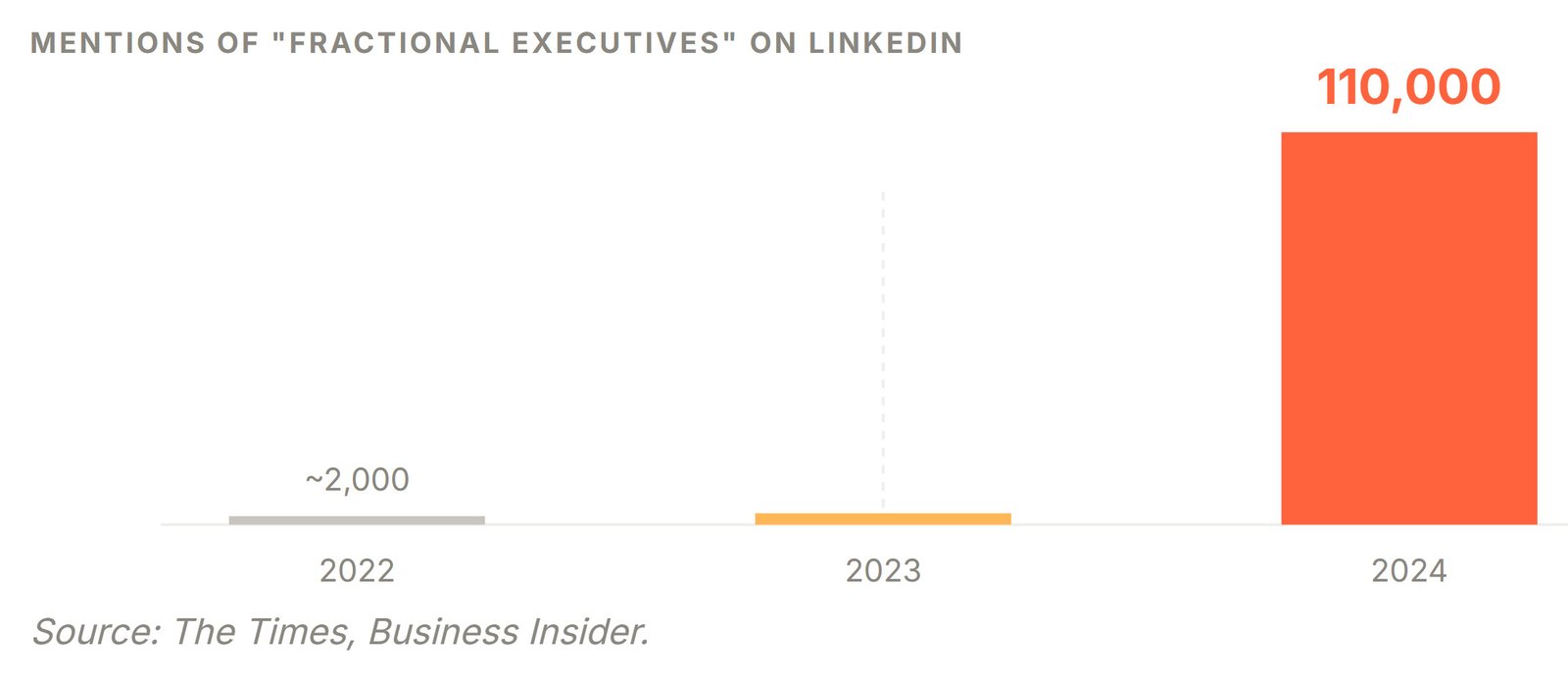
Cultural shift – Mentions of “fractional executives” on LinkedIn jumped from ~2,000 in 2022 to 110,000 in 2024 (The Times, Business Insider).
Launch risk – 80% of new drug launches fail to meet market share expectations within two years (Deloitte, 2023).
Why fractional leadership is growing
1. Market pressure
Pricing scrutiny, reimbursement complexity, and evolving global regulatory landscapes are raising the stakes for every launch — especially for emerging biotechs with an early-stage pipeline. A misstep can have existential consequences.
2. Talent scarcity
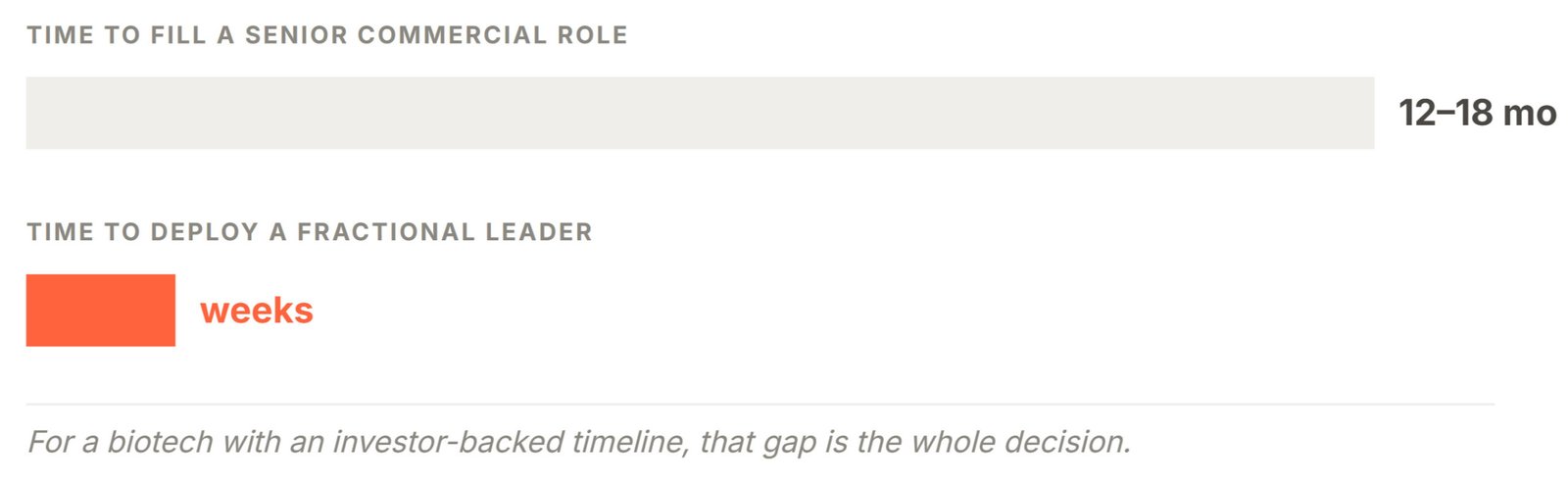
Filling senior commercial leadership roles — particularly in digital, analytics, and launch execution — can take 12 to 18 months. For emerging biotechs, that’s too long to wait, especially when investors expect rapid progress.
3. Flexibility & speed
Fractional leaders can be deployed within weeks, bringing deep functional expertise precisely when it’s needed — without the long-term financial commitment of a full-time hire.
4. Digital transformation
Commercial launches today require advanced data capabilities, AI-driven insights, and integrated MarTech ecosystems. These needs may not justify a permanent role in smaller companies, but still demand seasoned leadership to implement effectively.
Why it matters for commercial launches
- Accelerate pre-launch strategy — quickly establish market entry strategies, access planning, and cross-functional readiness roadmaps.
- Provide execution oversight — align marketing, market access, and field teams under one unified vision.
- Enable data-driven course correction — introduce KPI dashboards and performance tracking to adjust tactics in real time.
- Offer targeted crisis intervention — step in to stabilize an underperforming launch without requiring a permanent leadership change.
A conversation, not a conclusion

The question isn’t whether fractional leadership works. It’s whether it fits where you are.
The eqBridge Perspective
Bridging scientific success and commercial reality
At eqBridge, we’ve seen firsthand how fractional leadership can close the gap between a strong clinical result and a launch that lands. Our fractional leaders:
- Rapidly deploy into commercialization-critical roles to maintain momentum.
- Build resilient launch frameworks that can adapt to market volatility and regulatory changes.
- Integrate advanced data and analytics to ensure every launch decision is informed by real-time insights.
We want to hear from you. Do you agree with this perspective? Are you seeing similar trends in your networks, or does your experience tell a different story? Reach out and let us know at info@eqbridge.com.